AI Table Stakes
Stop debating AI strategy while your people can't access basic tools. Here's the minimum every business needs to provide to be in the game.
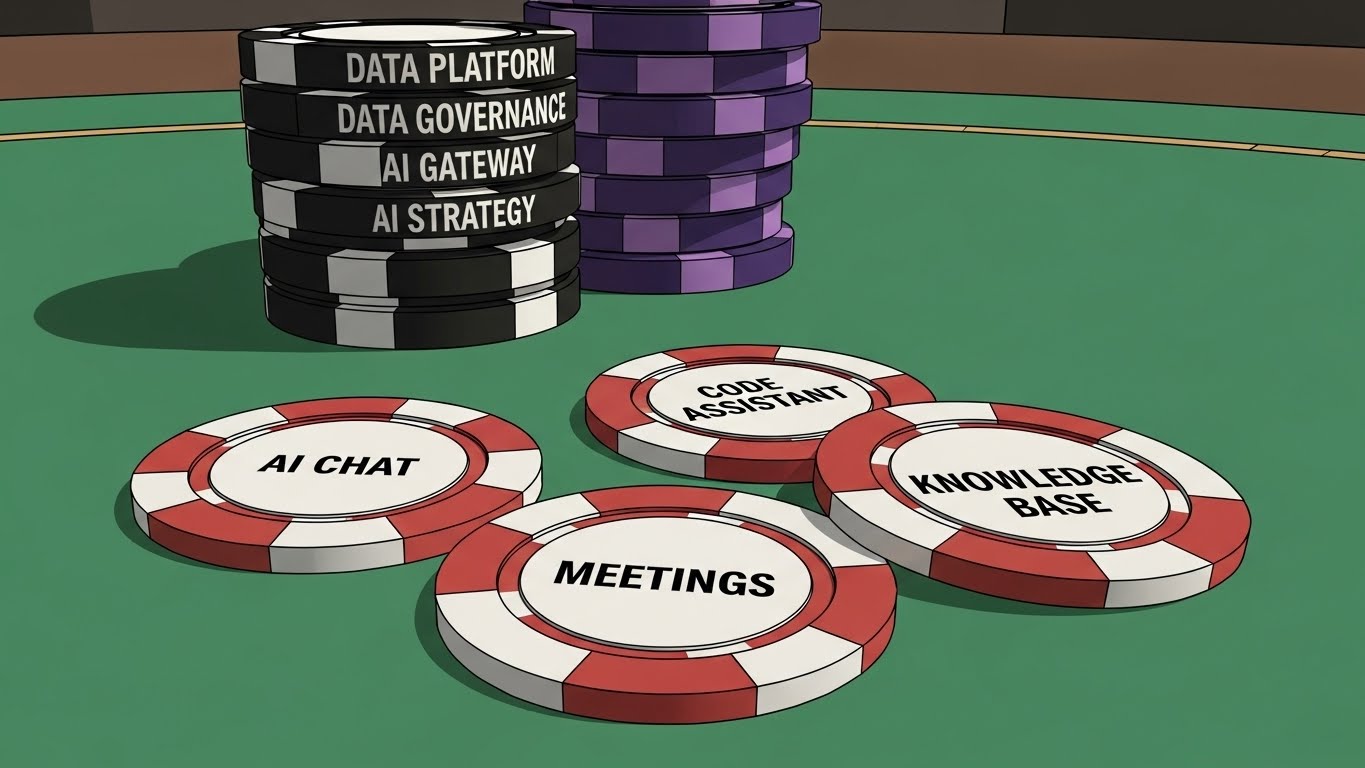 Image: Generated with Google ImageFX (Imagen 3) | See prompt
The Game Has Changed
Every round of technology raises the stakes on what it takes to compete. The “office” suite. A website. Internet connectivity. A mobile app. Each time, businesses that moved slowly paid the price. Now, with the availability of advanced AI agents and tooling, the stakes have risen again - what was a competitive edge twelve months ago is now a minimum requirement.
Today’s AI Table Stakes are:
- AI Chat Assistant
- Meeting Transcription
- Code Assistant
- Company Knowledge Base
What You Need to Play
These are probably the tools you’d expect, and yet surprisingly many organisations continue debating AI strategy and pilots while their people can’t access them. The question needs to shift from “what’s our AI roadmap?” to “how can we provide the bare minimum AI tooling to our workforce?”
AI Chat Assistant
First on the list is the standard AI Chat Assistant: Claude, ChatGPT, Gemini, etc. These tools are becoming almost ubiquitous in everyday life helping with tasks such as travel planning, recipe generation, and even motivational coaching. For workers, an AI Chat Assistant can provide a significant uplift, not only helping with drafting, editing, and summarising documents, but also providing a research and thought partner to supercharge productivity throughout the day.
Meeting Transcription
Utilising AI to transcribe meetings, provide summaries, and generate action items frees up workers from taking notes so that they can better focus on the meeting itself. As well as dedicated transcription tools such as Otter.ai and Fireflies.ai, most video meeting platforms such as Zoom and Teams have the capability built-in.
Code Assistant
If you have software engineers, commercial AI assisted coding tools like Claude Code, Cursor, and OpenAI’s Codex are continually improving, and open source alternatives like Cline and OpenCode are not far behind. Even used sparingly, these tools can lift testing coverage and documentation in a fraction of the time it would take a developer to manually complete, but your best software engineers will realise a massive uplift in delivered code without compromising on quality.
Company Knowledge Base
Unlike traditional static documentation, AI assisted company knowledge bases such as Glean, Guru, and Slite automatically capture, update, and summarise content from varied sources such as PDFs, Slack messages, and CRM systems, then provide instant, conversational answers to employee or customer queries. The barrier for these solutions is now trivially low: it is possible to spin up an OSS solution such as AnythingLLM in an afternoon.
How You Play Your Hand
The focus needs to be on Productivity over Conformity. There’s no value providing everyone access to Microsoft Copilot if no one uses it - no matter how good a deal Microsoft gives you. The fact is we are still in the early days of accessible AI, and there is no clear “best”. The key is to be flexible: some users will prefer ChatGPT, others Claude, others Gemini. Just like software developers have their preferred coding tools, so too will other workers have their preferred AI tools. Of course, being flexible doesn’t mean ceding control or throwing security out the window. Businesses still need to understand their risk appetite and the likelihood of disaster (and its cost). The reality is that the major players have enterprise plans that protect data, provide enhanced security, and have integrated access controls. When coupled with good guidelines and basic training, these are often enough to get started.
The Cost of not Playing
What’s the cost of not playing? Borders Group were slow to the game when the table stakes were raised by online shopping and eBooks. Now they’re just a Wikipedia entry.
Shadow IT
Shadow IT has been around at least as long as SaaS products and a handy credit card. Workers are probably already using personal accounts to get things done, with zero governance and visibility. By not providing options, you’re not avoiding risk, you’re just blind to it.
Talent Walks
The war for talent is real. Recruiting and retaining talented employees is becoming increasingly competitive. Denying that talent the ability to use the AI tools they rely upon and have access to at other places will put you further and further behind.
Productivity Tax
Without the benefit of AI tooling, every task takes longer. Multiplied across every employee, every day, that tax adds up. Even a simple ROI calculation is compelling: a $20/month tool that saves 30 mins/week provides >300% ROI at a salary of $100,000 per annum.
Addressing the Objections
We’ve all heard the excuses, but they’re starting to ring hollow:
- “We can’t let people paste client data into ChatGPT”: The objection isn’t wrong it’s just that it’s been solved by Enterprise tiers, guardrails, and local models.
- “We can’t afford $20/user/month”: conservatively, 30 mins/week saved is almost 3 days a year, the math just doesn’t support it.
- “We’re evaluating”: Two years is not diligence, it’s paralysis.
- “Who owns this?”: This is a valid question but doesn’t need to be a blocker, just decide and adapt as you grow.
Get in the Game
At some point, diligence becomes delay. The table stakes have risen again, and it’s time to pony up - AI Chat Assistants, Meeting Transcription, Code Assistants, and Company Knowledge Bases are now the minimum needed to compete. There are options for every budget and risk tolerance, so the only losing move is not to play.
Image prompt: Illustration of a poker table. Foreground: four separate white and red poker chips lying flat, each with one label: “AI Chat”, “Code Assistant”, “Meetings”, “Knowledge Base”. Background: tall stack of black and purple poker chips labeled “Data Platform”, “Data Governance”, “AI Gateway”, “AI Strategy”. Cel-shaded art style, hand-drawn line art, graphic novel illustration, green felt table, stylized illustration.